
ATD Blog
Designing Microlearning That Makes the Most of Attention
Content
Microlearning doesn’t ask us to do less as designers; it asks us to be more intentional.
Microlearning doesn’t ask us to do less as designers; it asks us to be more intentional.
Wed Jan 28 2026

Content
Microlearning holds real promise, especially as conversations shift toward using short-form learning more intentionally than doomscrolling. Its flexibility and proximity to real work allow it to fit naturally into busy days.
Microlearning holds real promise, especially as conversations shift toward using short-form learning more intentionally than doomscrolling. Its flexibility and proximity to real work allow it to fit naturally into busy days.
Content
To unlock that potential, though, we need to explore beyond length and delivery and focus on something more foundational: design awareness .
To unlock that potential, though, we need to explore beyond length and delivery and focus on something more foundational: design awareness.
Content
Microlearning doesn’t ask us to do less as designers; it asks us to be more intentional.
Microlearning doesn’t ask us to do less as designers; it asks us to be more intentional.
Attention Is a Resource Worth Designing For
Content
Rather than worrying about shrinking attention spans, learning science invites us to think differently. Attention isn’t something people either have or don’t have; it’s a limited resource that’s allocated moment by moment.
Rather than worrying about shrinking attention spans, learning science invites us to think differently. Attention isn’t something people either have or don’t have; it’s a limited resource that’s allocated moment by moment.
Content
Cognitive Load Theory helps explain why. People can only process so much information at once, but not all mental effort is equal. Some effort is spent on what matters—making sense of ideas, connecting concepts, deciding how to act. Other effort is spent navigating unclear explanations, unnecessary visuals, or competing work demands.
Cognitive Load Theory helps explain why. People can only process so much information at once, but not all mental effort is equal. Some effort is spent on what matters—making sense of ideas, connecting concepts, deciding how to act. Other effort is spent navigating unclear explanations, unnecessary visuals, or competing work demands.
Content
Well-designed microlearning respects attention by reducing the friction between learning and its application . It helps people spend their mental energy on meaning rather than interpretation.
Well-designed microlearning respects attention by reducing the friction between learning and its application. It helps people spend their mental energy on meaning rather than interpretation.
Content
Think of it like making pizza.
Think of it like making pizza.
Content
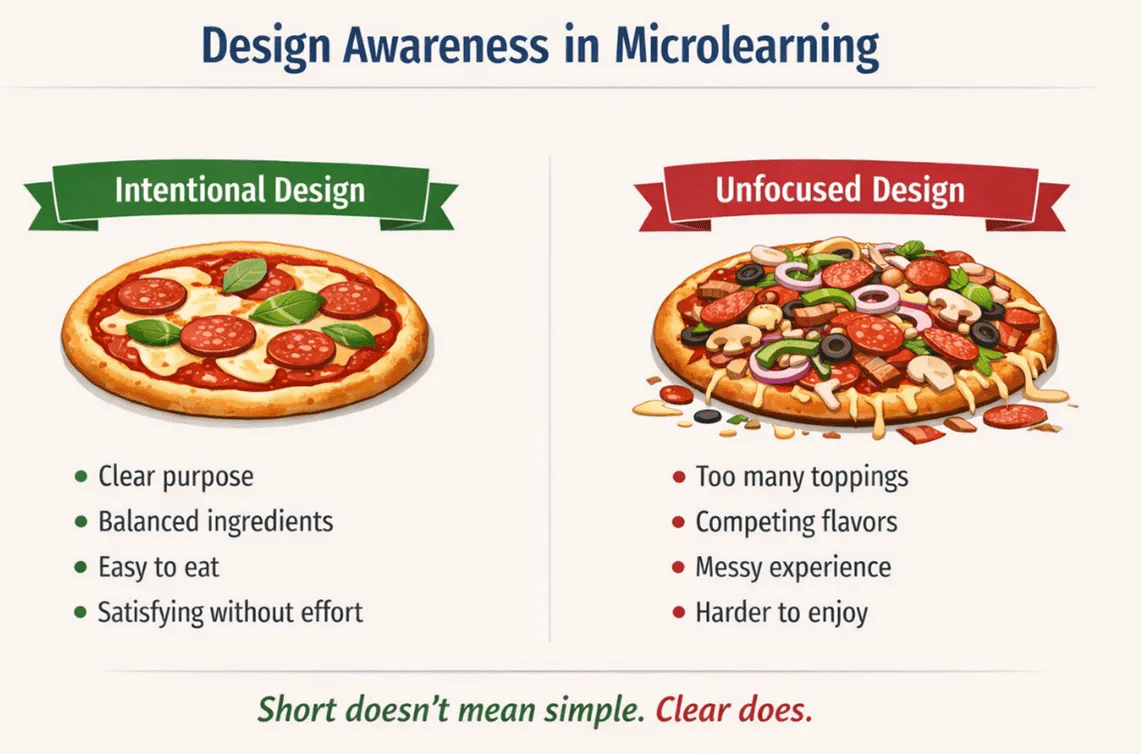
If you have a can of tomatoes, you already have what you need to make a simple sauce. From there, you make intentional choices: how thick the crust should be, how much sauce to use, and which toppings actually belong together. A good pizza relies on balance. Each ingredient has a role, and nothing fights your palette for attention.
If you have a can of tomatoes, you already have what you need to make a simple sauce. From there, you make intentional choices: how thick the crust should be, how much sauce to use, and which toppings actually belong together. A good pizza relies on balance. Each ingredient has a role, and nothing fights your palette for attention.
Content
Now consider the non-example.
Now consider the non-example.
Content
The same pizza, but every topping is added “just in case.” Extra sauce, multiple cheeses, too many meats and vegetables. Nothing is technically wrong, but the result is heavy and unfocused. It’s harder to eat, harder to enjoy, and the original intent gets lost under the weight of good intentions.
The same pizza, but every topping is added “just in case.” Extra sauce, multiple cheeses, too many meats and vegetables. Nothing is technically wrong, but the result is heavy and unfocused. It’s harder to eat, harder to enjoy, and the original intent gets lost under the weight of good intentions.
Content
Microlearning works the same way.
Microlearning works the same way.
Content
When we’re clear about the outcome, we can make deliberate design choices about what stays and what goes. When we’re not, we tend to add content to compensate for uncertainty. The learning experience may still be short, but the cognitive effort required to make sense of it increases.
When we’re clear about the outcome, we can make deliberate design choices about what stays and what goes. When we’re not, we tend to add content to compensate for uncertainty. The learning experience may still be short, but the cognitive effort required to make sense of it increases.
Content
Good microlearning isn’t about using fewer ingredients. It’s about using the right ones purposefully.
Good microlearning isn’t about using fewer ingredients. It’s about using the right ones purposefully.
Microlearning Benefits from Clear Design Decisions
Content
A single microlearning product is like a slice of pizza: a complete, intentional experience designed for a specific moment, building knowledge, developing a skill, or supporting performance. A microlearning campaign is the whole pie: a coordinated set of related products that work together over time. Each slice needs to stand on its own, but the pie only works if the slices belong together.
A single microlearning product is like a slice of pizza: a complete, intentional experience designed for a specific moment, building knowledge, developing a skill, or supporting performance. A microlearning campaign is the whole pie: a coordinated set of related products that work together over time. Each slice needs to stand on its own, but the pie only works if the slices belong together.
Content
Because microlearning is brief, every design choice matters more. There’s less room for ambiguity, excess, or misalignment. That’s not a limitation, it’s an opportunity. Intentional microlearning design makes thoughtful decisions about:
Content
What the focus truly is
What the focus truly is
Content
What context is essential for understanding
What context is essential for understanding
Content
What can be removed without losing meaning
What can be removed without losing meaning
Content
What supports use, not just exposure
What supports use, not just exposure
Content
When those decisions are made consciously, microlearning becomes easier to engage with; not because it’s short, but because it’s clear.
When those decisions are made consciously, microlearning becomes easier to engage with; not because it’s short, but because it’s clear.
Short Can Still Be Thoughtful
Content
One common misconception is that shorter learning experiences are easier to design. In reality, they often require more judgment. Removing content without redesigning purpose or flow can unintentionally increase cognitive effort, asking people to infer meaning or fill in gaps on their own.
One common misconception is that shorter learning experiences are easier to design. In reality, they often require more judgment. Removing content without redesigning purpose or flow can unintentionally increase cognitive effort, asking people to infer meaning or fill in gaps on their own.
Content
Thoughtful microlearning doesn’t compress; it clarifies . It keeps what matters and lets go of what doesn’t.
Thoughtful microlearning doesn’t compress; it clarifies. It keeps what matters and lets go of what doesn’t.
Designing for Use, Not Just Access
Content
Another way to strengthen microlearning is to design with use in mind. Access alone doesn’t guarantee impact. Learning science consistently shows that understanding deepens when people reflect, decide, or act. Microlearning can support this by extending beyond itself:
Another way to strengthen microlearning is to design with use in mind. Access alone doesn’t guarantee impact. Learning science consistently shows that understanding deepens when people reflect, decide, or act. Microlearning can support this by extending beyond itself:
Content
A reflection prompt tied to real work
A reflection prompt tied to real work
Content
A decision question grounded in context to the task or job role
A decision question grounded in context to the task or job role
Content
A small action that connects learning to practice
A small action that connects learning to practice
Content
These don’t need to be complex. They just need to be intentional.
These don’t need to be complex. They just need to be intentional.
A Simple Way to Get Started
Content
If there’s one easy step that can immediately improve microlearning design, it’s this:
If there’s one easy step that can immediately improve microlearning design, it’s this:
Content
Before designing anything, write one sentence that answers: “ What do I want someone to be able to do, think differently about, or decide after this? ”
Before designing anything, write one sentence that answers: “What do I want someone to be able to do, think differently about, or decide after this?”
Content
Not “what will they watch” or “what will they complete,” but what changes . That single sentence becomes a filter:
Not “what will they watch” or “what will they complete,” but what changes. That single sentence becomes a filter:
Content
If something doesn’t support it, it can likely go.
If something doesn’t support it, it can likely go.
Content
If something competes with it, it probably doesn’t belong.
If something competes with it, it probably doesn’t belong.
Content
If something strengthens it, it earns its place.
If something strengthens it, it earns its place.
Content
This small habit builds design awareness, and design awareness is what allows microlearning to do its best work.
This small habit builds design awareness, and design awareness is what allows microlearning to do its best work.
Moving Forward with Confidence
Content
Microlearning isn’t about racing against attention or lowering expectations. It’s about making deliberate choices within constraints. When we approach it with clarity, respect for attention, and a focus on use, microlearning becomes not just efficient but effective.
Microlearning isn’t about racing against attention or lowering expectations. It’s about making deliberate choices within constraints. When we approach it with clarity, respect for attention, and a focus on use, microlearning becomes not just efficient but effective.
Content
The good news is this: You don’t need new tools or trends to get there. You just need to pause, decide consciously, and design with purpose.
The good news is this: You don’t need new tools or trends to get there. You just need to pause, decide consciously, and design with purpose.
Content
That’s something every designer can do—starting now.
That’s something every designer can do—starting now.
Content
For a deeper dive, join me at ATD26 for the session: Maximizing Microlearning: Chunk, Strip, Build Your Design Skills.
For a deeper dive, join me at ATD26 for the session: Maximizing Microlearning: Chunk, Strip, Build Your Design Skills.