
What is Instructional Design?
What is Instructional Design?
Instructional design, also known as instructional systems design or instructional systems development (ISD), is the practice of creating learning experiences to support long-term learning. It's a systems approach to analyzing, designing, developing, implementing, and evaluating any instructional experience.
ISD is based on the belief that training is most effective when it provides learners with a clear statement of what knowledge they will gain and how their performance will be evaluated. This definition and more information on ISD are in the TDBoK™ Guide: Talent Development Body of Knowledge.
In the workplace, instructional design provides a practical, systematic process for delivering effective training to the target audience. It's one of the 23 capabilities in the Talent Development Capability Model™.
Skills, Tips & Career Path with Nicole Papaioannou Lugara
What Is an Instructional Designer?
An instructional designer applies learning theory to design course content, learning activities, and other training solutions to support the acquisition of new knowledge or real-world skills. Instructional designers develop all instructional materials of a training program, including presentation materials, participant guides, handouts, job aids, and other resources. They are also responsible for evaluating training, assessing what was learned, and determining if the learning solution led to measurable behavior changes.
What Does an Instructional Designer Do?
An instructional designer is someone who figures out what people need to learn and creates the best way for them to learn it. In simple terms, they:
Talk to stakeholders to understand a problem or skill gap.
Define clear learning objectives (what learners should be able to do afterward).
Design and build training—like courses, videos, workshops, or job aids.
Choose the right format (online, in-person, or blended).
Check whether the training worked and improved performance.
Prior to designing and developing the course, an instructional designer conducts a needs assessment. This determines the stakeholder goals, whether the training is necessary, and the needs of the learning event. A needs assessment will determine:
Organizational goals and needs
Knowledge, skills, and attitudes required for tasks and competencies
What the learner should know and be able to do because of the training
Learner needs and characteristics
One way to determine learners’ needs and course objectives is to use Bloom’s Taxonomy. Bloom’s Taxonomy is a system used to define and distinguish different levels of learning. The three domains include cognitive (mental), affective (emotional), and psychomotor (physical).
Once an instructional designer analyzes the needs assessment and understands the training objectives, the course creation process can begin. The instructional design process requires selecting the most appropriate strategies, methodologies, learning activities, and technologies to maximize the learning experience and knowledge transfer.
Think of instructional designers as the architects of learning experiences. They don’t just deliver information, they design it so people can understand it, remember it, and use it on the job.
Skills Required for Instructional Designers
Instructional designers need a blend of foundational design skills, business/consulting capabilities, and technology fluency. ATD frames these through the Talent Development Capability Model and instructional design programs.
1. Core Instructional Design Process Skills
ATD emphasizes mastery of the full design cycle (often aligned to ADDIE). Training and development specialists can follow a systematic process in their design, including these foundational, “traditional” ID skills still considered essential:
Needs assessment & analysis – identifying performance gaps and business needs
Writing measurable learning objectives
Designing learning experiences (structure, sequencing, learner flow)
Developing content and materials (courses, job aids, and e-learning)
Implementation across modalities (classroom, virtual, e-learning)
Evaluation of effectiveness (measuring outcomes and impact)
2. Learning Science & Learner-Centered Design
Instructional designers must have a baseline understanding of adult learning theory and be able to apply its principles to course design. ID professionals must design training materials and courses that engage, motivate, and promote application—not just content delivery. Use varied instructional strategies tailored to different learners, and focus on outcomes rather than information in the learning process.
3. Technology & Multi-Modal Design Skills
Modern instructional designers must be able to design for multiple delivery formats (in-person, virtual, e-learning, mobile). This means being fluent with learning technologies (LMS, authoring tools, multimedia) and able to create training programs across formats (videos, infographics, podcasts, digital learning assets).
4. Business & Communication Skills
To grow the talent development department and instructional designer role, shift from “order-taker” to strategic partner. This means going beyond being the organization’s expert on instructional design principles to develop business acumen (aligning learning with organizational goals), consultative skills (working with stakeholders to define real needs), and a problem-solving mindset (addressing performance, not just training requests).
In addition, instructional designers must effectively partner with subject matter experts (SMEs), communicate clearly through instructional writing, and facilitate feedback and iteration with stakeholders.
5. Design Thinking & Innovation
Instructional design is more than building courses—it’s about designing performance-focused, learner-centered solutions. The best instructional designers are no longer just designers. They’re strategic performance consultants who use learning as a tool, stay current with emerging trends and technologies, adapt to changing workforce needs, and continuously expand their skill set beyond traditional design.
Stay ahead of corporate training trends by continuously improving your design thinking skills. Implement rapid prototyping, iterative development and testing, and learner-centric and accessible solutions into your training programs.
Adult Learning Theories in Learning Design
Instructional designers can use adult learning theories to identify learner characteristics and select instructional design methods to create effective learning solutions.
Common adult learning theories include:
Knowles’ Theory of Andragogy: Malcolm Knowles is credited with developing this theory in the 1970s. Andragogy differs from pedagogy in that adult learners bring their experiences with them to guide their learning journeys. Adults have more choice and control over their learning environment. Andragogy is the cornerstone of all adult learning theories.
Gagne’s Nine Events of Instruction: A widely known and systematic approach to creating effective learning design. When completed in order, the nine events lead to better engagement and improved retention.
Maslow’s Hierarchy of Needs: Maslow categorizes human needs into five categories: physiological, belonging, esteem, and self-actualization. According to this theory, optimal learning requires that psychological and safety needs are met.
Meier’s Accelerated Learning: This theory includes seven guiding principles that enhance the design and learning processes. Understanding cognitive science and how the brain works can help designers select appropriate strategies to enhance learning.
Instructional Design Models Made Simple
ADDIE
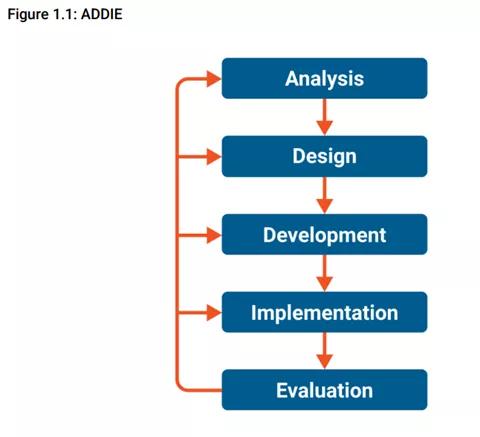
This model is one of the most well-recognized instructional design models. Founded in the 1970s at Florida State University, ADDIE outlines five phases: analysis, design, development, implementation, and evaluation. The steps are foundational for almost any learning design activity.
A primary advantage of ADDIE is that it consistently produces training that helps learners acquire the shared knowledge and skills needed for effective job performance. ADDIE’s primary disadvantage is its high level of systematicity. This can cause talent development professionals to overlook other considerations outside the ADDIE framework.
SAM (Successive Approximation Model)
This model encourages the evolution of requirements and the development of learning solutions through stakeholder collaboration. By using repeated steps, or iterations, to continuously improve the learning product, SAM allows designers to work within real project constraints, including limited time and cost. On the other hand, the collaborative nature of SAM requires input from many individuals, which can lead to delays.
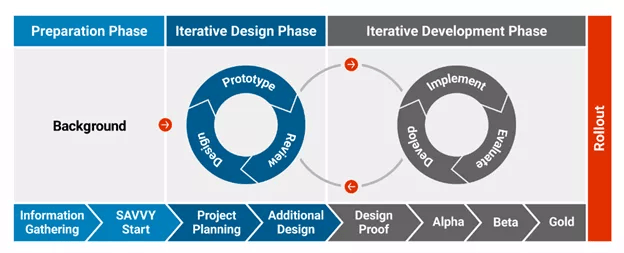
Seels and Glasgow Model
This model uses the context of project management as the basis for design. Like SAM, this model is iterative and relies on feedback and interactions throughout the process.
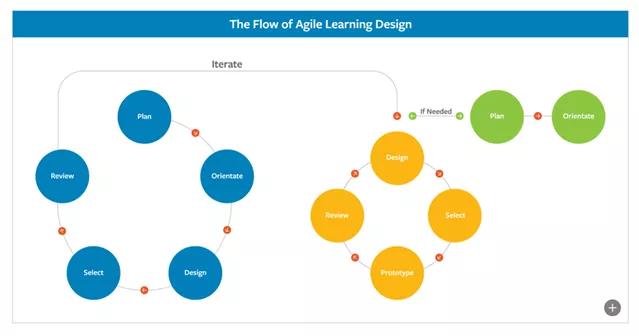
Agile or rapid prototyping
With its roots in software development, Agile uses cross-functional teams to foster collaboration. Agile uses an iterative, incremental design approach to encourage the evolution of requirements and the development of solutions through stakeholder collaboration. As a result, Agile is often used to maximize customer value.
Benefits of Instructional Design for Organizations
At a basic level, instructional design helps organizations solve real performance problems. Instead of creating training for its own sake, instructional designers analyze the cause of the gap (skills, knowledge, process, or environment) and design solutions that directly address it. This means organizations spend less time and money on ineffective training and more on solutions that work. In short, instructional design helps organizations move from “training people” to improving performance and achieving business results.
Improves employee performance and productivity: Well-designed learning experiences make it easier for employees to understand, retain, and apply new skills on the job. Learning should lead to behavior change and measurable outcomes, so instructional design helps bridge the gap between learning and doing.
Consistency and scalability: Instructional design creates structured, repeatable learning experiences that can be delivered across teams, departments, or even globally. This ensures everyone is trained to the same standard while still allowing different formats, such as e-learning, virtual, or in-person delivery.
Strengthens alignment with business goals: Instructional designers work with stakeholders to ensure training supports priorities like growth, innovation, compliance, or culture, making learning a strategic driver rather than a support function.
Tools Used in Instructional Design
Instructional designers use a range of tools to create effective learning. Courses may be any combination of asynchronous, synchronous, in-person, and virtual. It is very common for instructional designers to create blended training programs. For example, one program might have an online course component for the instruction, but then include an in-person evaluation. Instructional designers should be familiar with the following educational technology:
Content creation and design tools are what instructional designers use to turn ideas and objectives into actual learning experiences. This includes e-learning authoring tools, presentation software, video editing programs, and graphic design platforms. These instructional technology tools help designers build courses, visuals, and multimedia content that make learning engaging and easy to understand.
Learning platforms and delivery systems are used to distribute training and track progress. Learning Management Systems (LMS) and Learning Experience Platforms (LXP) allow organizations to assign training, monitor completion, and sometimes personalize the learner’s journey. These systems help organizations manage and scale learning effectively.
Collaboration and project tools support the highly collaborative nature of instructional design work. Designers regularly work with subject matter experts and stakeholders, so they rely on project management platforms, shared documents, and communication tools like chat and video conferencing. These tools are essential to executing projects successfully.
Evaluation and advanced technology tools help measure effectiveness and enhance learning experiences. Survey tools, quizzes, and analytics platforms are used to determine whether learners met the learning objectives and whether performance improved. In addition, emerging tools like AI, virtual classroom platforms, and interactive technologies are expanding what’s possible and enabling more personalized and data-driven learning experiences.
Use AI in Instructional Design
How ATD Can Help You With Instructional Design?
Since 1943, ATD’s focus has been to help talent development professionals succeed in their roles. Through instructional design, ATD curates the best content from the world’s leading experts in the field, providing designers with opportunities to learn the latest techniques using the latest technologies.
ATD explores talent development holistically; we understand how instructional design fits with evaluation, training, and other aspects of workplace learning. We are a leading industry organization that defines standards for the field of instructional design and talent development.
For access to even more resources, including practical tools and templates, research, and insights, become an ATD member. Learn more!
Recommended Resources
Instructional Design Certificate
As an instructional designer, you have the power to shape organizational outcomes by designing learning experiences that give participants the knowledge and skills needed to perform their jobs well. To be an effective instructional designer, you need a structured, step-by-step design process that you can rely upon to create outcome-based training.
In this Instructional Design Certificate course, you’ll gain access to the leading approaches, design models, and tools you need to create transformative learning events. The program consists of 10 modules that address all aspects of the instructional design process in detail: assessing organizational needs; understanding and designing for knowledge, skill, and attitudinal gaps; developing instructional materials; and evaluating effectiveness—giving you a complete playbook for creating training programs.
As you go through the course, you’ll have the opportunity to practice each step of the design process—getting guidance and feedback along the way. You will apply what you learn to a case study that simulates a real-world work scenario.
Writing for Instructional Design and Training Certificate
As a talent development professional, writing is a core part of your job. To communicate effectively with stakeholders and learners, develop high-quality training materials, and facilitate learning, your writing needs to be persuasive, clear, and engaging. By mastering these writing skills, you’ll gain credibility and a competitive edge as you need to create learning content that educates, communicates, and engages.
Discover how to use writing techniques to articulate desired training outcomes in this instructional design writing certificate. Through hands-on practice and scenarios specific to talent development, learn how to write to clarify, simplify, illuminate, and explain. Find out how to use tone, point of view, and personality to keep your audience actively engaged. Become skilled at organizing and formatting your writing to enhance understanding and reduce cognitive load. Learn more about the writing for instructional design and training certificate and find a session that works for you.
Virtual Instructional Design Certificate
Intentional and thoughtful instructional design is necessary for successful virtual learning events. Well-designed virtual courses (specifically, instructor-led synchronous online courses), supported by well-designed materials and learning objectives, keep adult learners motivated and engaged throughout the online learning experience. The virtual instructional design certificate is designed to help instructional designers turn virtual learning into a top-tier experience.
Creating engaging and effective virtual training requires more than transforming in-person training materials into an online format. It involves designing and developing materials for instructors, producers, and remote online learners using proven virtual learning methods and instructional design principles that maximize engagement, knowledge transfer, and overall learning outcomes.

BLOGS
Instructional Design Topic Page
Explore instructional design articles for all levels. Find strategies, insights, and best practices to elevate your expertise. Start here!

NEWSLETTER
Instructional Design Newsletter
Sign up for curated content for professionals who design learning experiences and materials. Sign up today!

COURSES BY ROLE
Instructional Designers
Discover courses tailored for instructional designers creating online learning events, conducting needs assessments, evaluations, and more. Explore courses!

EVENTS
ATD Events
Talent development professionals come together to give you conference experiences that are diverse in education, solutions, and opportunities. Learn more!

GLOSSARY TERM
Talent Development Glossary Terms
Learn about essential terms and need-to-know expressions for training and development professionals. Explore now!
Free Instructional Design Starter Guide
Instructional designers are responsible for creating the course design and developing all instructional material.